A practical path from finding a car in Japan to getting New Zealand plates on it.
Start here before bidding. Import eligibility, paperwork and shipping choices should be confirmed before money changes hands. A cheap car that cannot be certified in New Zealand is not a bargain.
Where to find cars
For most private NZ buyers, the realistic options are public dealer listings, exporter stock, or using an auction agent. Japanese trade auction networks exist, but you normally cannot buy from them directly.
Trade auction networks
USS and AUCNET are major Japanese auction networks, but they are not realistic direct-buying options for an ordinary NZ buyer. Access is generally restricted to licensed businesses, so use an exporter or auction agent that can search and bid through these networks for you.
Ask your exporter whether they can search TAA, JU, JAA, CAA and regional auction houses. Compare agent fees, translations, inspection support and cancellation rules before bidding.
Before placing a bid
Set a maximum hammer price and an all-in Japan budget. Confirm buyer fees, consumption tax treatment, inland transport, storage, cleaning, inspection and export-document charges.
Do the checks in order. Eligibility and documents are hardest to fix after the vehicle has already been purchased or shipped.
01
Check NZ eligibility
Confirm the exact model code, chassis number, build date, emissions, frontal-impact and ESC requirements with NZTA guidance or an entry certifier.
02
Inspect the listing
Read the full auction sheet and inspector comments, check the chassis number, request extra photos and confirm recall status.
03
Buy the vehicle
Agree on the purchase price, exporter or auction-agent fees, inland transport, storage, inspection, cleaning and payment terms in writing.
04
Deregister for export
The Japanese agent must arrange deregistration for export and obtain the original Export Certificate. Do not accept recycling paperwork as a substitute.
05
Prepare and ship
Arrange inland transport, cleaning, export processing, marine insurance and RORO or container shipping. Retain every invoice.
06
Clear the NZ border
Your broker or freight forwarder handles Customs and MPI clearance using the purchase, ownership, freight and shipping documents.
07
Complete SIV if needed
Prepare evidence early, but lodge the Special Interest Vehicle application after the vehicle has arrived at the NZ port and before entry certification.
08
Comply and register
Send the vehicle and original documents to an entry certifier. Repair any faults, complete certification, obtain a WoF, register and fit NZ plates.
An unlisted emissions code does not automatically mean the vehicle cannot comply. If the Japanese emissions prefix or model code is not on NZTA’s list, compliance may still be proven using other approved evidence, such as a statement of compliance, an appropriate compliance plate, or evidence from independent testing carried out to the requirements of an approved vehicle standard. A normal tailpipe test alone is not enough. Confirm the evidence pathway with an entry certifier or NZTA before purchasing the vehicle. Read NZTA Technical Bulletin 28 ↗
Reading auction sheets
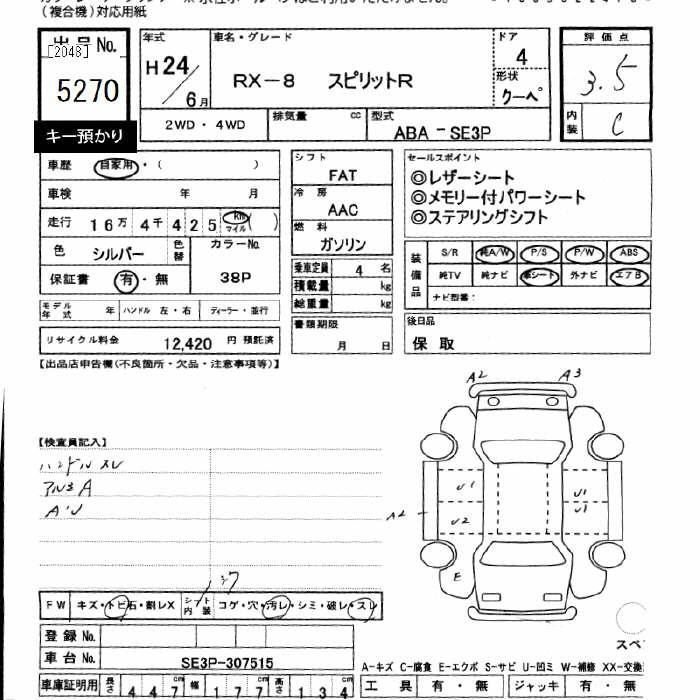
An auction grade is only a summary. The inspector notes, damage map, photos and chassis details matter more than the headline number.
Identity block
Match the chassis number, model code, first-registration year, engine size, transmission and trim with the vehicle being offered. Japanese registration year is not always the manufacturing year.
Inspector comments
Get a human translation. Look for warning lights, smoke, oil or coolant leaks, corrosion, flood signs, modified structure, missing parts, unusual noises and odometer comments.
Interior and exterior grades
These are separate from the overall auction grade. A high overall grade can still have worn trim, odours, stains, paint defects or underbody corrosion.
Damage diagram
Letters mark the defect type and numbers usually indicate severity. Codes vary between auction houses, so use the legend printed on that sheet.
The body diagram marks condition notes such as A2 and A3 scratches. Always translate the handwritten inspector comments and confirm the chassis number before bidding.
4.5–5Typically excellent or near-new, but still inspect the notes.
4Generally good used condition with minor defects.
3–3.5More visible wear, repairs or maintenance risk.
R / RARepaired accident history. Certification risk needs extra checking.
AScratch
UDent
WRepair mark or panel wave
X / XXNeeds replacement / replaced panel
SRust
CCorrosion
YCrack or split
GGlass chip or damage
Do not buy from the grade alone. Ask for the original sheet, translation, current photos, underbody images and a chassis-number check. Auction houses use different grading systems and symbols.
Required documents
Names can vary between agents and shipping lines. Keep originals, clear scans and proof of every payment. Entry certification may require original documents.
Proof of vehicle and ownership
Purchase invoice or bill of sale showing buyer, seller, vehicle and price
Original auction sheet and a reliable English translation
Chassis number and model-code confirmation
Proof of payment
Odometer inspection or verification documents where supplied
Pre-export inspection, cleaning or heat-treatment records where applicable
Export Certificate
Original Japanese Export Certificate / Certificate of Deregistration for Export
Accurate English translation
Vehicle details must match the chassis plate and invoice
This must be export deregistration — not a recycling or scrapping certificate
The original export certificate is one of the most important documents for NZ entry certification. Arrange secure delivery of the original paper, not only a scan.
Freight documents
Bill of Lading or sea waybill
Arrival notice
Transport or shipping-company invoice
Freight and marine-insurance invoice or certificate
Japan inland-transport and port-processing invoices
Container packing list when containerised
Border and compliance file
NZ Customs Number for imports valued above NZ$1,000
Customs import entry and release
MPI biosecurity clearance
Importer identification and contact details
Evidence of ownership
Standards evidence requested by the entry certifier
SIV permit, repair certification or other exemption evidence when applicable
Special Interest Vehicle permits
A Special Interest Vehicle permit can provide an exception for an eligible vehicle that does not meet New Zealand's frontal-impact, exhaust-emissions and/or electronic-stability-control requirements. It can be especially useful for collector and high-performance cars that are not yet old enough to qualify for the 20-year exemptions, provided the vehicle and applicant meet the SIV criteria.
Vehicle qualifying criteria
NZTA must consider that the vehicle will be owned as a collector's item. It must either have historic value, or evidence must show that it meets at least three of these four criteria:
The make, model or sub-model is identified as a collector's item in a qualifying commercially produced motoring publication or website
The make and model had annual production of 20,000 vehicles or fewer
It was manufactured as a two-door coupe or convertible
It was manufactured as a high-performance vehicle
Applicant requirements
The permit is issued to an eligible person, not simply to the vehicle. The applicant must:
Be a New Zealand citizen or resident
Have another primary-use vehicle registered in their name, leased to them or supplied as a company vehicle
Have had no SIV permit issued to them in the previous two years
Have no other SIV registered in their name
Submit a complete witnessed application, supporting evidence and the required fee
Before buying
Confirm the exact vehicle and evidence pathway with NZTA or an entry certifier before bidding. Collect reputable evidence for every criterion you intend to rely on.
Exact make, model, sub-model, variant and chassis number
Production-volume or limited-edition evidence
Qualifying collector-publication evidence
Performance specifications and original configuration
Application and certification
The signed declaration must be witnessed by an entry certifier, who sends the application and evidence to NZTA. Approval is required before entry certification and registration.
Keep the vehicle off public roads until certified
Supply the approval to the entry certifier
Do not assume approval until NZTA confirms it in writing
Important SIV limits. NZTA can issue no more than 200 SIV permits in a calendar year. A permit becomes invalid if the vehicle is not border inspected or entry certified within six months of issue. The permit only covers the approved exceptions to frontal-impact, exhaust-emissions and/or electronic-stability-control requirements. The vehicle must still meet all other applicable standards, and modified or repaired vehicles may need additional certification. When an exception is used, the vehicle must remain registered in the permit holder's name for at least four years after its first New Zealand registration. Check the current NZTA SIV requirements ↗
Freight-only services
If you are not using an all-in-one stock and export service, you can source or purchase the vehicle yourself and use a freight company for the export, shipping, border clearance and NZ delivery stages. There are more providers available, but these are the ones we have used ourselves or heard good things about.
General guidance only. Requirements differ by vehicle, age, source market, standards evidence, damage history and exemption pathway. Confirm the exact vehicle with NZTA, your entry certifier, freight forwarder and Customs broker before purchase.